
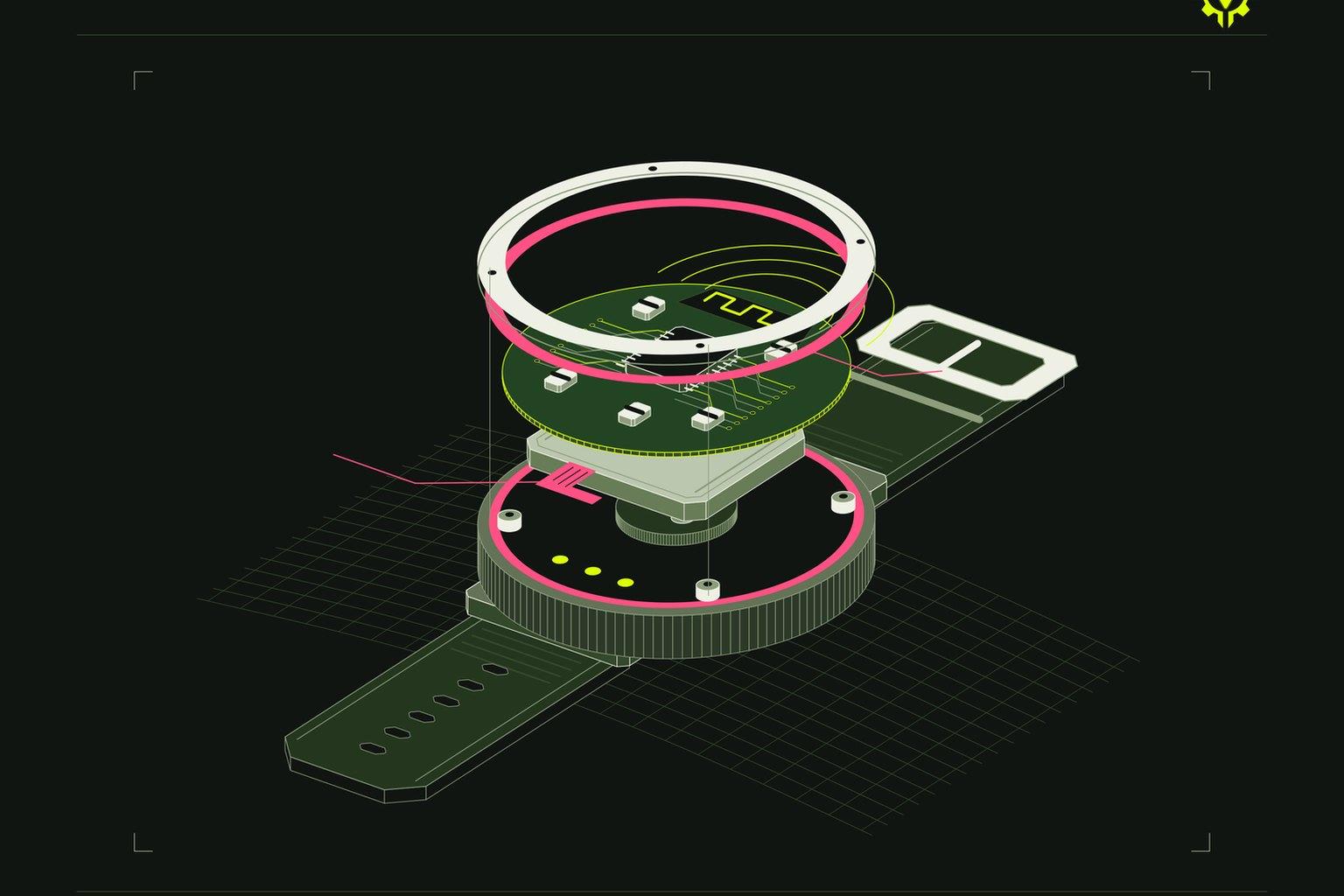
A wearable that measures thirty-odd metres of BLE range on the bench will often measure a couple of metres once the same board is closed in its case and strapped to an arm. Nothing has broken. Every part still does what it did an hour ago. What changed is that a pouch cell shifted a few millimetres to make room for a charging contact, a metal buckle ended up near the radio, and a wrist full of salt water arrived behind all of it.
Nobody owns the gaps
The usual setup is an electronics contractor, a mechanical contractor and a firmware contractor, all competent, all delivering what was asked for. The board passes review and the CAD is clean; the firmware runs happily on a dev kit. Then the parts meet each other and the product fails in the space between them, where an antenna sits too close to a metal bracket and the same gasket that seals the case lifts the optical sensor off the skin, and where a thermal problem gets handed back and forth because it is half mechanical and half electrical. On a wrist device those handover points are where the product actually lives, and unless one person is answerable for them they get discussed and never solved.
The seams need an owner before the microcontroller needs a part number.
The wrist sets the budget before you do
Start from the arm and work inwards. People will wear roughly 38 to 42 mm across and about 10 to 12 mm thick before they stop wearing it, and that ceiling is not negotiable by argument. Out of that comes 1.2 to 1.5 mm of wall each side for a moulded ABS or PC housing with usable draft, plus the display stack and clearance for a pouch cell that will swell maybe ten percent over its life and must never sit under preload, which leaves something like 55 to 90 mAh.
At that point the electronics budget is arithmetic. Ninety milliamp hours across seven days is about 530 microamps average, and average is the only number that matters. An nRF52 or STM32WB class part sleeps at two or three microamps. BLE advertising at a one second interval costs you tens of microamps. A PPG front end firing its green LED at 25 mA for 100 ms once a minute costs about 40 microamps averaged, and the same sensor run continuously costs you the entire device. An accelerometer sampling at 25 Hz draws a few microamps and barely registers against the budget; push the raw stream out over a 15 ms connection interval and the radio duty cycle alone will eat most of the week.
The part number is rarely the decision. The duty cycle is.
Antenna, battery, skin
Wearable PCB design is mostly an exercise in giving things up. The antenna wants a keepout with no copper, no battery, no metal and no wrist behind it, and on a 35 mm board you have none of those to give. A chip antenna detunes by tens of megahertz against tissue, which is why the pi matching network is three placeholder components on rev A and a real tuning session with a VNA on rev B. A match tuned on an open bench jig tells you very little about the radio you will actually ship. Tune it in the enclosure, on a person, or do not bother tuning it.
Give the cell the same honesty. A lithium battery in a product means UN 38.3 testing, and that decides how you are allowed to ship, not how you are allowed to design. Look it up in month one. Founders learn about it when the units are already boxed.
Skin contact is a mechanical problem wearing an electrical badge
A PPG heart rate sensor arrives as a chip in a reel and then behaves like a machined assembly. It needs a window pressed against skin with consistent force, so the back of the case ends up curved and slightly proud, and strap tension becomes part of the sensor specification. It needs an opaque wall between the LED and the photodiode, because light that takes the short path through the plastic instead of through tissue swamps the signal. That wall is a mechanical feature that exists to fix an electrical problem, and it is exactly the kind of thing that falls through the gap when three contractors are working to three separate specifications.
We built firmware for a brainwave headband once: sensor interface, signal processing, LED indicators, BLE. The electronics were one half of that job and the head it sat on was the other.
What we would actually do
Print the ugly puck first. Ahead of the schematic, ahead of any real layout work, we would FDM a solid dummy at the target thickness with the target weight in it, wear it for three days and find out whether the thing is wearable at all. That costs an afternoon. Finding out after tooling costs a steel mould.
Then we would freeze the mechanical envelope and give the board a stack-up, a keepout map and a battery position, in that order, and only then lay out. Firmware starts the same week, on a dev kit wired to the real sensors, with UART logging and debug hooks built in from the beginning rather than bolted on when something misbehaves at 3 am. The pitch deck describes a wearable as a firmware project. The geometry is decided long before firmware gets a say, and firmware spends the rest of the programme living with it.
Expect three boards, not one. The first wrist-worn rev tells you where the antenna, the strap and the skin interface disagree with the CAD; the second fixes those and surfaces the quieter ones, a sensor reading that drifts with strap tension or a charge contact that corrodes; the third is the one you can put in a box and sell. Money that runs out after the first rev has paid for a demo that fits a wrist once.
And cut features. A band that does heart rate and step count and lasts a week beats a band that does nine things and is still in development. We would rather argue for that early, when it is free, than at the point where the change costs a respin and eight weeks of lead time.
Got a wearable on the bench and a nagging feeling about where it will come apart? Send us the enclosure CAD and the current power budget, and we will tell you which one of them is lying.