
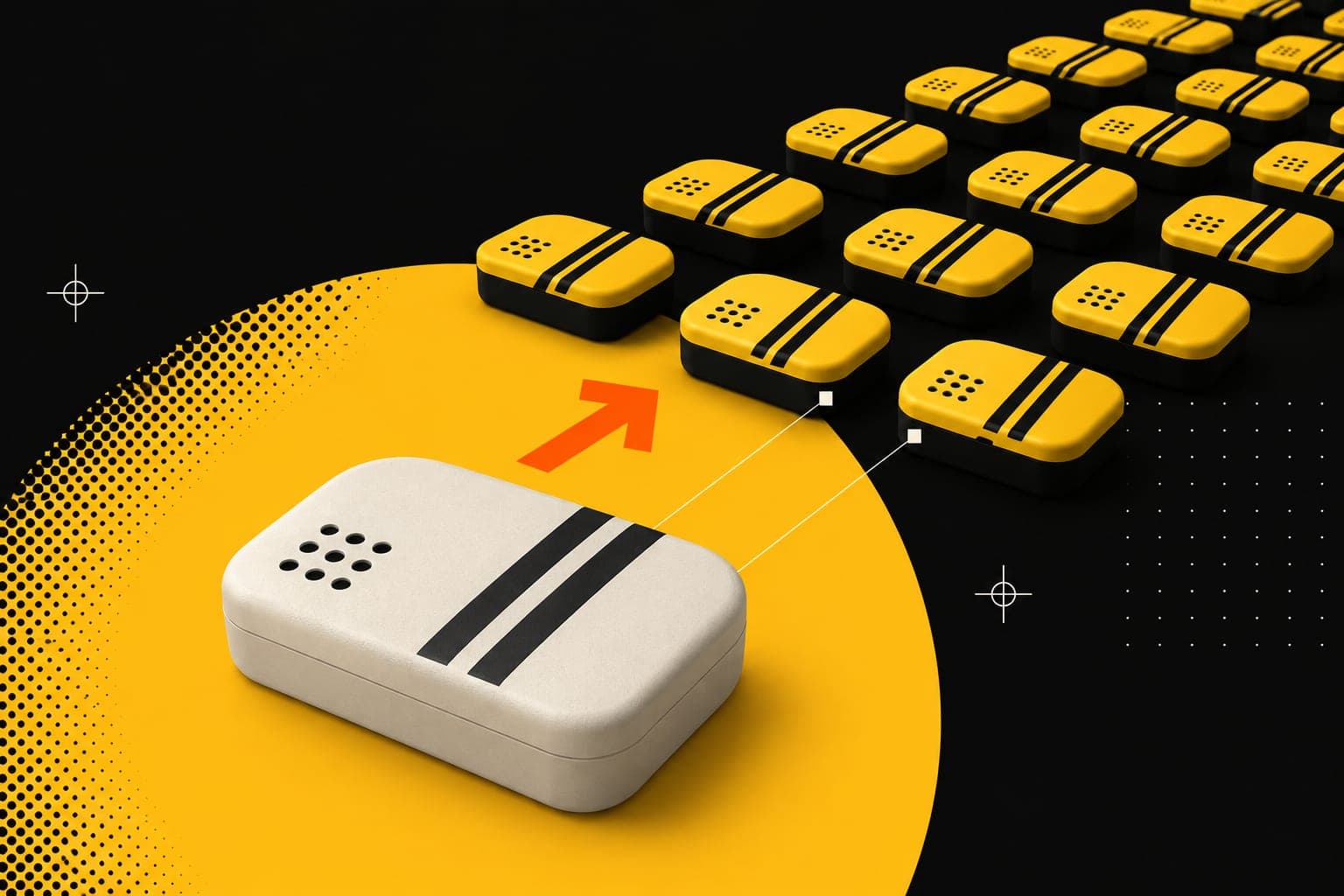
Going from a working prototype to mass production means redesigning your product for manufacturability, validating it against real standards, and qualifying a factory that can build it repeatably. A bench prototype proves the idea works once. Production proves it works ten thousand times, built by people who have never met you, from parts you can actually buy.
Most first-time founders underestimate this gap. Expect six to twelve months and a design that changes more than you think.
Start with a design for manufacturing review
Your prototype was optimized for speed. Production hardware is optimized for yield, cost, and testability, and those are different goals.
A DFM review looks at every part of the design against how it will actually be built. On the PCB side that means component footprints, panelization, solder mask and stencil openings, test point access, and whether the assembly house can place your parts on their standard line.
On the mechanical side it means draft angles, wall thickness, tolerance stack-up, and choosing between injection molding, die casting, or CNC based on your volume. A part that prints fine on your desktop printer may be impossible to eject from a steel tool.
Do this review before you spend money on tooling. Changing a mold after it is cut costs thousands and weeks.
Solve the supply chain before you finalize the design
Your bill of materials is a purchasing document, not just a parts list. Every line needs a real manufacturer part number, a lead time, a minimum order quantity, and ideally a qualified second source.
Single-sourced parts are the most common reason production stops. If a component has one supplier and a twenty-six week lead time, design an alternative in now while the schematic is still open.
Also check lifecycle status. A chip marked not recommended for new designs will disappear halfway through your second production run.
Build a pilot run and test it properly
Before full production, build a small batch on the real line with the real tooling, typically twenty-five to a hundred units. This is where you find the problems no prototype will show you: the connector that seats crooked, the firmware flash step that takes four minutes instead of thirty seconds, the enclosure that rattles.
Run the same units through environmental and compliance testing. EMC is the usual surprise. A product that radiates slightly over the limit may need a board respin, a shield, or a filter, and finding that out after mass production is an expensive lesson.
You also need a production test fixture and a test plan. Someone at the factory has to be able to confirm each unit works and program it without reading your source code. Firms that handle the whole chain, from PCB layout and firmware through EMC and factory production, tend to catch these dependencies early because the same team owns both ends. Warning Engineering works this way.
Qualify the factory, not just the quote
The lowest quote is rarely the cheapest outcome. Ask about their inspection process, AOI and ICT capability, defect rates on similar boards, and what happens when a batch fails.
Get a signed quality agreement covering acceptance criteria and rework responsibility. Then stay involved. Plan on being present, in person or by video, for the first production run.
Prototype to production is mostly about removing ambiguity. Every assumption you leave in the design becomes a defect someone else has to discover at volume, so spend the time closing them while changes are still cheap.
If you are working through this transition and want engineers who have done it before, reach out to us at https://warning-engineering.com.