
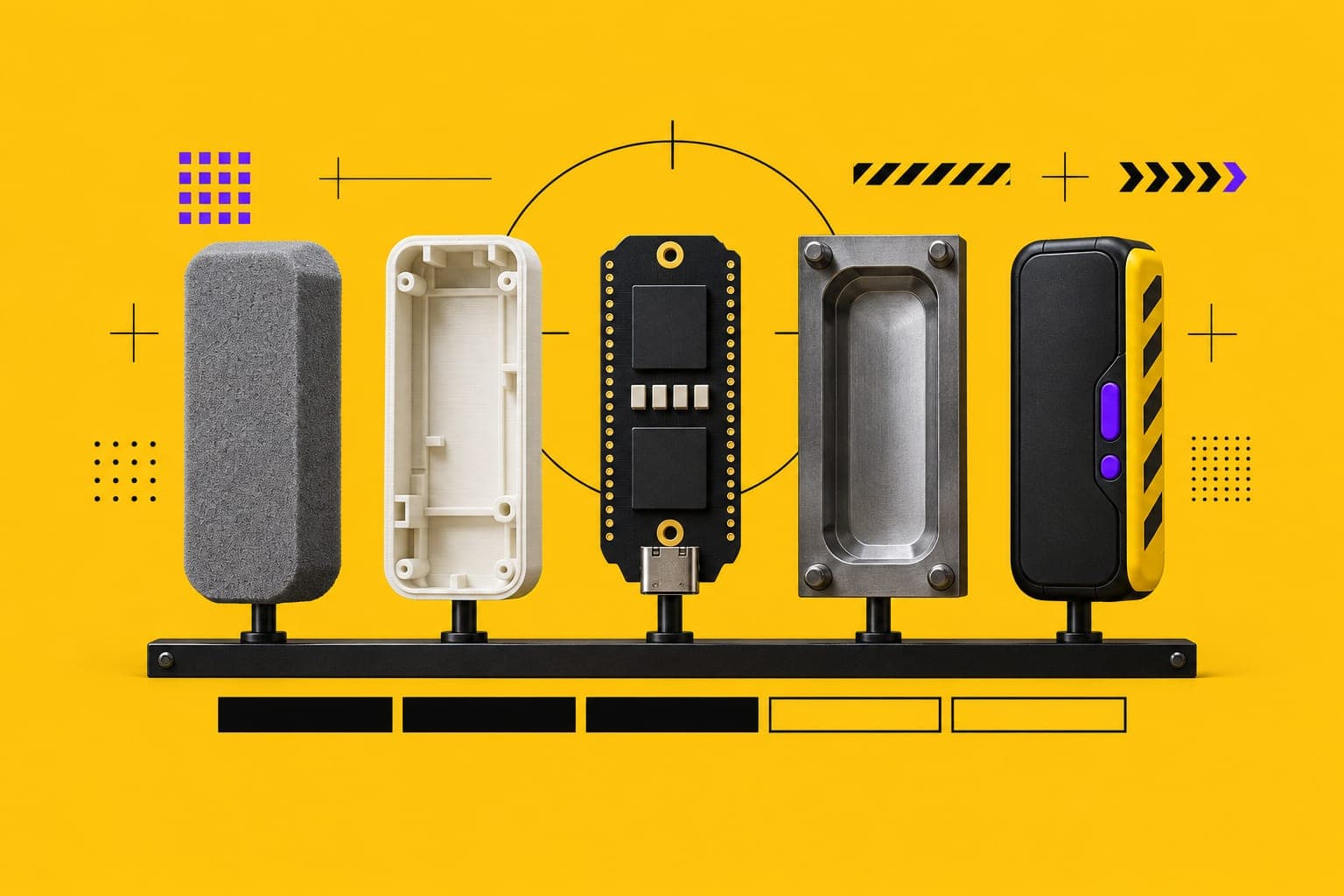
Nine to eighteen months, from a defined idea to units coming off a line. That is the honest range for most electronic products. A simple accessory built around an off-the-shelf module can be done in six. A regulated medical or industrial device with custom silicon and a heavy certification load can run two to three years.
The spread has little to do with engineering talent. Almost every hardware schedule is dominated by queue time: the fab slot, the mold being cut, the lab booking, the part that ships in forty weeks. Adding engineers compresses the design work, which was never the long part.
The clock belongs to the supply chain
A microcontroller quoted at forty weeks sets your launch date no matter how fast the firmware gets written. Tooling behaves the same way. Mold design, cutting and first-shot samples run eight to sixteen weeks, and every modification after that is another few weeks of someone else's calendar. If the product carries a lithium cell, it cannot legally fly to a test lab or a trade show until UN 38.3 testing is done, and that is a booking, not a task you can work harder at.
None of those numbers respond to pressure. You cannot pay a mold to cure faster, and there is no premium tier on a certification lab's schedule in a busy quarter.
So when a date slips past the season that mattered, the only lever that actually moves is scope. Drop the second radio, drop the colour variant, and rebuild the parts list around things that are in stock this week. A better plan does not shorten a forty-week lead time. A smaller parts list does.
Nobody's first board is the product
Budget for rev B and rev C from the start.
Schematic and layout take three to six weeks per revision. Fabrication and assembly add two to four more, depending on where you build and how exotic the parts are. Call it six to ten weeks door to door per spin. Three revisions is a reasonable plan, two is optimism, and four is normal on a complex mixed-signal design.
Firmware usually becomes the long pole after the second board revision, once the hardware stops moving underneath it. Mechanical rarely sets the pace at this stage: a machined enclosure part comes off the CNC here in seventy-two hours and a printed one lands the same day. Boards are the bottleneck because boards have to travel.
Teams that plan for one revision do not save those weeks. They spend them in month eleven, when the calendar has no slack left and the trade show they built the schedule around is three weeks out.
The two weeks that decide the other fifty
Two planning failures cost more than any other. The first is picking a battery before anyone has measured what the radio draws when it is actually transmitting, which is how a product ends up with a cell that will not fit the enclosure that was already tooled. The second is choosing target markets late, so a device designed for CE marking acquires an FCC requirement in month nine and has to go back through a lab it has already left.
Founders want to skip that and open a schematic. It is the most reliable way we know to turn a nine-month project into a two-year one. Change the radio module or the battery chemistry at month ten and you have touched the PCB, the firmware, the mechanical design and the certification plan in a single move, and each of those has its own queue to rejoin at the back.
Decide late and the decision stops being a decision. By month ten the choices that are still open are only the ones nobody can afford to reopen, and the rest were made for you by whatever was already ordered. One of our published examples, an e-bike project, went from brief to a working prototype in ninety days, with an aluminium frame, a 250W hub motor and the BMS housed in the seat tube.
Certification and the pilot run
A design that works still has to become manufacturable: test fixtures, panelization, second-sourced components, and a pilot build of twenty to a hundred units that proves the process rather than the product.
Certification overlaps this. Pre-compliance EMC work catches most problems cheaply. Full CE or FCC testing at an accredited lab takes two to six weeks once a slot opens, and a failure sends you back for a board spin and then back into the queue behind everyone who booked while you were fixing it. Radio, safety, medical and automotive standards each add months, and they tend to add them in series rather than in parallel.
Then the ramp. Long-lead orders go out months before the first mass build, a golden sample gets signed off, and the factory quotes four to eight weeks of build time after materials land.
Where the handoffs go
Electronics, firmware, mechanical and manufacturing are one team here with one point of contact. The seams between disciplines are our problem, not the client's.
Ask whoever quotes you a launch date which part on the bill of materials has the longest lead time, and if they cannot answer, the date is decoration.